

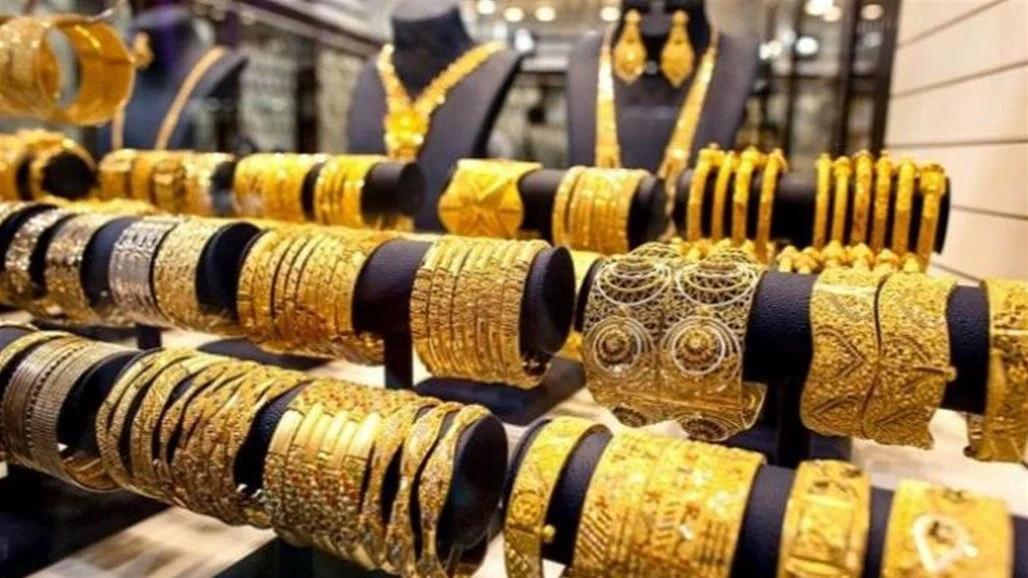
Gold prices remained near the 1 million IQD mark on Sunday. Gold prices in Iraq showed mixed movement across Baghdad and Erbil markets. Baghdad prices stayed largely unchanged, while Erbil recorded lower rates for several categories.
In Baghdad, 21-carat Gulf, Turkish, and European gold sold for 1,006,000 IQD per mithqal. A mithqal equals five grams in the local gold market. Buyers paid around 1,002,000 IQD for the same gold. The price matched Saturday’s selling rate.
Iraqi 21-carat gold traded at a lower level in Baghdad. Sellers offered the metal at 976,000 IQD per mithqal. Buyers paid about 972,000 IQD. The gap reflects differences between imported varieties and locally produced gold.
Jewelry shops also showed a similar pattern during Sunday’s trading. Gulf 21-carat gold ranged from 1,005,000 to 1,015,000 IQD per mithqal. Iraqi gold ranged between 975,000 and 985,000 IQD. Prices varied slightly among individual stores and market locations.
Erbil’s market presented a different picture during the same trading session. Dealers listed 22-carat gold at 1,035,000 IQD per mithqal. Meanwhile, 21-carat gold reached 988,000 IQD. The 18-carat variety traded at about 847,000 IQD per mithqal.
The latest figures highlight different price movements between Iraq’s two major commercial centers. Baghdad maintained Saturday’s level for several widely traded 21-carat varieties. Erbil, however, recorded lower prices compared with recent market levels. Gold prices in Iraq continue to reflect differences between local markets and gold purity.
Market watchers often track the mithqal price when assessing daily gold movements. The unit remains widely used by jewelry traders and customers across Iraq. Currency movements, international gold prices, and local demand can all influence retail rates. Shop-level prices can also change depending on workmanship and product origin.
For buyers, the distinction between carat levels remains important. Higher-carat gold contains a greater proportion of pure gold. Jewelry prices can also include workmanship charges, which differ between stores. Customers therefore may pay more than the quoted market rate for finished pieces.
Sunday’s figures suggest relative stability in Baghdad despite continued movement elsewhere. The unchanged Baghdad price gives traders a clear reference point from Saturday’s session. Erbil’s lower rates indicate that regional market conditions can produce different daily results. Gold prices in Iraq therefore remain worth watching across both markets.
The latest market survey provides a snapshot of retail gold conditions rather than a fixed nationwide price. Traders may adjust their rates throughout the day as market conditions change. Consumers should compare buying and selling prices before completing transactions. Daily quotations can also differ based on purity, origin, and jewelry design.