

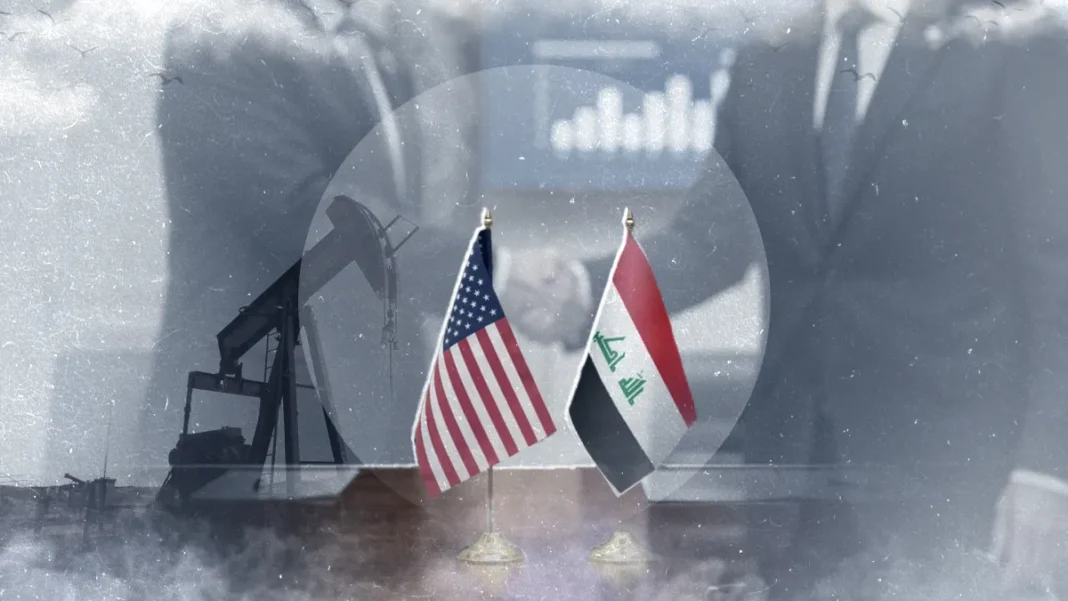
Washington is making a stronger play for Iraq’s oil industry as Baghdad pursues higher production. The U.S. oil push in Iraq comes as Russia faces mounting pressure and China protects its regional interests. Iraq’s ambition to lift output toward 8–10 million barrels daily has raised the stakes.
Iraq remains one of the world’s most important untapped oil markets. The country holds about 145 billion barrels of proven crude reserves, according to U.S. government estimates. Its exceptionally low production costs make many Iraqi fields attractive to international energy companies. Those advantages have also made Iraq a strategic prize for competing global powers.
Iraq’s location adds another layer to the competition. The country borders Iran, Saudi Arabia, Kuwait, Jordan, Syria, and Turkey. It also provides access to major Gulf shipping routes and important regional energy corridors. Control over its energy infrastructure can therefore carry influence far beyond oil revenues.
For years, Russia and China expanded their positions across Iraq’s energy landscape. Russian companies gained significant influence in the Kurdistan Region. Chinese companies built a powerful presence across several major fields in southern Iraq. Their investments also connected oil production with infrastructure, refining, and other development projects.
Washington has increasingly challenged that balance during President Donald Trump’s second administration. U.S. sanctions have pressured Russian energy interests, particularly around Kurdistan. Western companies have also pursued new agreements covering major Iraqi fields and infrastructure. The strategy could give American firms greater influence over Iraq’s future production growth.
ConocoPhillips has now emerged as an important player in northern Iraq. The company agreed to acquire a 42% interest in BP’s Kirkuk venture. The project covers five producing fields around the historic Kirkuk oil region. Those assets include parts of the Kirkuk field, Bai Hassan, Jambur, and Khabbaz.
BP launched a major redevelopment program for the assets last year. The project carries a reported value of roughly $25 billion. Initial plans target production of around 328,000 barrels per day. Output could eventually rise toward 450,000 barrels per day if development progresses as planned.
The fields also contain substantial additional exploration potential. Estimates place their combined reserves at several billion barrels. Further resources could exist across nearby structures and surrounding acreage. That potential makes the Kirkuk agreement important for both commercial and strategic reasons.
Chevron is pursuing opportunities farther south. The U.S. company has advanced plans involving West Qurna 2 and the Nasiriyah field. West Qurna 2 ranks among Iraq’s largest oil developments, with billions of barrels in estimated resources. Its production could rise substantially through additional development phases.
Lukoil previously operated West Qurna 2 and maintained a major position there. Its departure has created an opening for another international operator. Chevron could benefit from existing infrastructure and growing Western participation across southern Iraq. The company could also gain from shared projects designed to improve water supplies for oil production.
Nasiriyah represents another potentially significant opportunity for Chevron. The field contains an estimated 4.36 billion barrels of oil resources. Iraq has considered developing it for decades, but successive plans faced financial and political obstacles. A new agreement could finally move the project toward sustained development.
The proposed development also connects with plans for a large refinery. That facility could process hundreds of thousands of barrels daily. Integrating production and refining could strengthen southern Iraq’s energy infrastructure. It could also support Baghdad’s broader plans to expand domestic energy capacity.
The competition extends beyond individual oil fields. Iraq needs major infrastructure investment to achieve its ambitious production targets. Water injection systems, export facilities, pipelines, refineries, and power supplies will all require substantial capital. Western companies could therefore secure influence through infrastructure as well as upstream production.
The U.S. oil push in Iraq also reflects Washington’s wider effort to limit rival influence. Russia’s war in Ukraine has constrained its ability to expand abroad. China remains deeply involved in Iraq, particularly through its extensive southern operations. Iran also retains strong political and security connections across the country.
Iraq, meanwhile, faces its own balancing act. Baghdad wants foreign investment without surrendering control over strategic resources. It must also manage competing relationships with Washington, Beijing, Moscow, and Tehran. The government’s production ambitions will require cooperation from several of these players.
For the United States, Iraq offers an opportunity to regain ground in a market where rivals expanded rapidly. American energy companies can provide capital, technology, and operational expertise. Their involvement could also reinforce Washington’s broader economic and strategic presence. That makes Iraq’s oil expansion an increasingly important geopolitical contest.
The coming years will determine whether Baghdad can turn its ambitious production targets into reality. Success will depend on investment, infrastructure, political stability, and reliable export capacity. If major projects advance, Iraq could become an even more influential force in global oil markets. The U.S. oil push in Iraq could then reshape the balance among Washington, Moscow, and Beijing.