

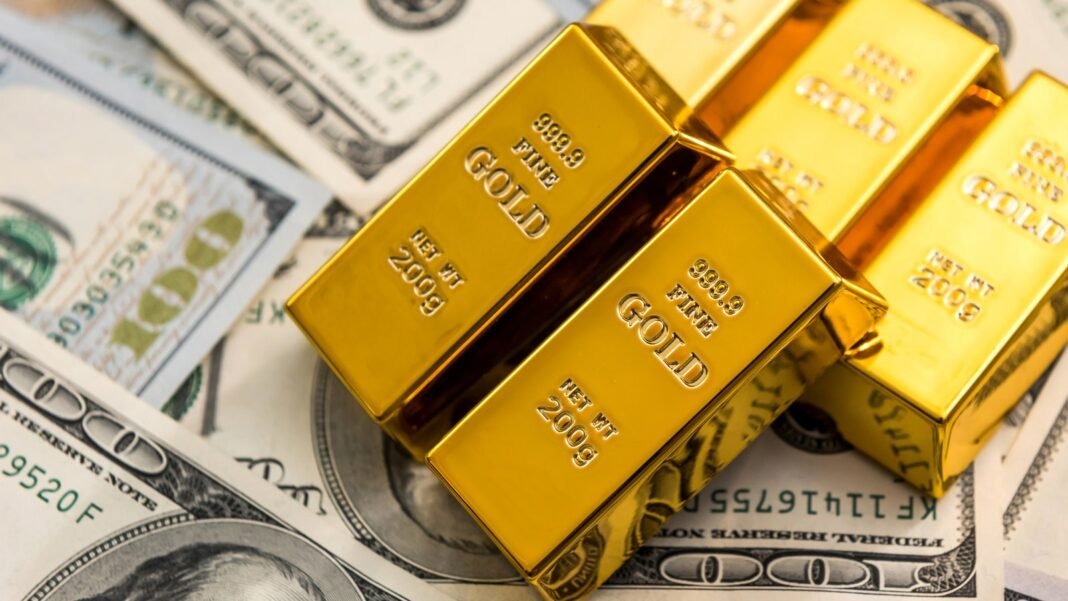
Gold prices rise once again as markets react to global uncertainty. On Tuesday, spot gold climbed 0.7% to reach $3,325.79 per ounce. U.S. gold futures also jumped 0.9%, hitting $3,337.30.
Several factors drove this increase. First, a weaker dollar made gold more attractive for international buyers. As the dollar dropped to a three-year low, gold became cheaper in other currencies. This helped boost buying interest.
Second, gold prices rise due to rising trade tensions. Investors worry about the July 9 deadline set by President Donald Trump. Unless trade talks succeed, heavy tariffs between 10% and 50% may take effect. This pressure has caused traders to seek safe-haven assets like gold.
Nicholas Frappell, head of institutional markets at ABC Refinery, noted that fear around Trump’s tariff plan supports gold demand. He explained that many investors want safety as trade talks show little progress.
Moreover, gold prices rise as expectations for U.S. interest rate cuts increase. Trump recently pushed the Federal Reserve to cut rates by comparing U.S. rates to those in Japan and Denmark. He suggested that U.S. rates should stay below 1.75%.
Lower interest rates make gold more appealing. That’s because gold does not pay interest, and cheaper borrowing makes holding gold more cost-effective.
Analysts at Goldman Sachs now predict three rate cuts this year. Previously, they expected only one. They believe slow job growth and low inflation could lead the Federal Reserve to act sooner.
Additionally, investors are waiting for U.S. jobs data this week. Many hope the results will guide the Federal Reserve’s next move.
Meanwhile, other precious metals moved slightly. Silver remained steady at $36.07 per ounce. Platinum dipped 0.5% to $1,346.41. Palladium, however, gained 1.3% and reached $1,111.60 per ounce.
In summary, gold prices rise due to market fears and economic signals. As trade talks struggle and rate cuts look likely, gold continues to shine.