

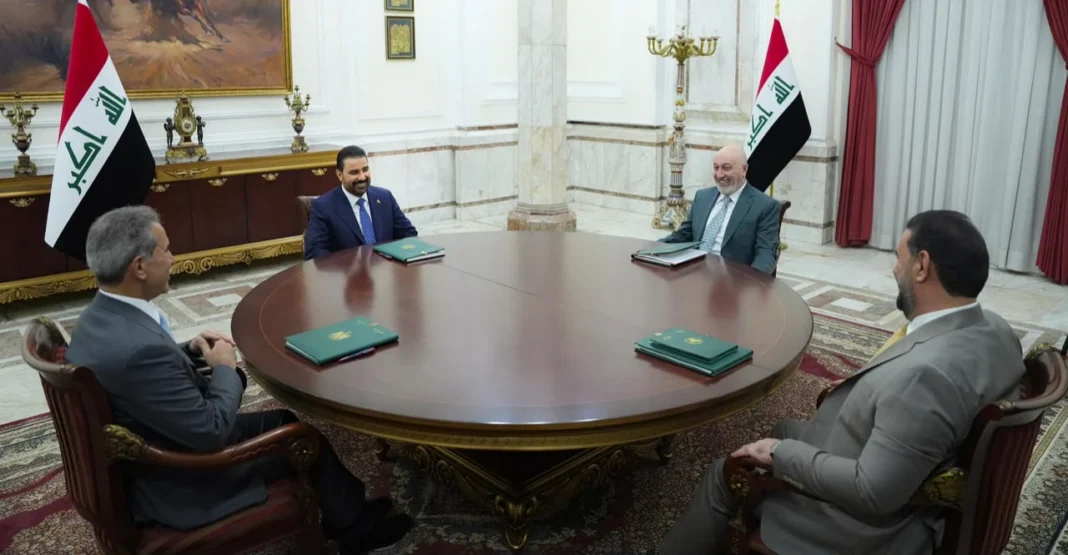
Iraq’s top political leaders met in Baghdad to address economic pressures, security concerns and regional tensions. Iraq economic resilience emerged as a central theme during the high-level discussions. The meeting also focused on government performance, corruption, legislation and the authority of state institutions.
Iraqi President Nizar Amedi hosted Prime Minister Ali al-Zaidi, Parliament Speaker Haibat al-Halbousi and Supreme Judicial Council President Judge Faiq Zaidan. The four officials reviewed domestic developments and discussed ways to strengthen coordination across Iraq’s main state institutions. They also backed efforts to advance the government’s ministerial programme and improve public services.
The leaders called for faster progress toward completing the cabinet formation. They said stronger coordination could help the government fulfill its responsibilities and address national priorities. They also stressed the importance of improving institutional performance and maintaining security across the country.
Economic concerns featured prominently in the discussions. Iraq has faced reduced revenues amid the wider regional conflict and disruptions linked to the closure of the Strait of Hormuz. The leaders therefore urged greater attention to economic diversification and stronger financial management.
They called for increased non-oil revenues to reduce the economy’s dependence on energy income. Such measures could help Iraq manage future shocks and protect essential public spending. The leaders described Iraq economic resilience as an important goal amid growing regional uncertainty.
Security discussions centered on the principle that weapons must remain under government authority. The officials reaffirmed state control as essential to the rule of law and national sovereignty. Their position comes as the international coalition continues its withdrawal process from Iraq.
The leaders also emphasized the need to strengthen Iraq’s armed forces and security institutions. They said those forces must have the capacity to protect citizens and defend the country. Stronger state institutions, they argued, would support greater stability and public confidence.
Corruption and the protection of public funds also received attention during the meeting. The officials renewed their support for measures targeting administrative and financial corruption. They also discussed proposed legislation designed to recover money lost through corruption and strengthen national integrity mechanisms.
The leaders urged parliament to accelerate work on priority legislation. They highlighted bills connected directly to citizens’ living conditions and public services. A stronger legislative and oversight role, they said, could support broader government reforms.
Regional tensions formed another major part of the meeting. The officials supported dialogue and diplomatic efforts aimed at reducing conflicts across the region. They also rejected attempts to use Iraqi territory for attacks or hostile operations against other parties.
The leaders stressed that Iraq should not become an arena for regional or international confrontations. They linked that position to protecting national sovereignty, security and stability. Their discussions ultimately connected economic reform, stronger institutions and security to Iraq economic resilience.
The meeting reflected a broader effort to strengthen Iraq’s ability to manage domestic challenges while avoiding involvement in regional conflicts. Its priorities included economic diversification, public-sector reform, anti-corruption measures and stronger security institutions. Together, the leaders presented these areas as key elements of Iraq’s effort to protect its national interests.