

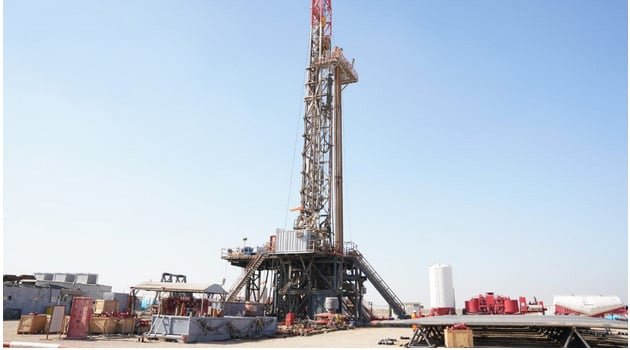
Iraq has increased its oil production significantly as DQOC boosts production through a new integrated development plan. The Dhi Qar Oil Company (DQOC) launched a multi-phase strategy to upgrade three major oil fields: Nasiriyah, Subba, and Garraf.
Additionally, DQOC General Manager Sa’id Zgair Shalaka confirmed the plan’s success in raising daily output. He explained that the Nasiriyah field now produces 70,000 barrels per day (bpd), up from 52,000 bpd. Engineers added seven new wells to achieve this jump in capacity.
Therefore, at the Subba field, which previously produced 8,500 bpd, production rose to 30,000 bpd. This boost came from linking eight wells and installing a new oil separation station. Shalaka emphasized that national teams are developing both fields without involving foreign contractors.
Meanwhile, the Garraf field has reached a stable output of 180,000 bpd. This site operates under a licensing agreement with international partners. The development of Garraf continues to serve as a model for mixed cooperation in Iraq’s energy sector.
Moreover, in parallel with oil production, DQOC boosts production of associated gas. At Garraf, the first phase of a gas processing project has been completed. The site now handles 37 million standard cubic feet per day (mmscfd) of gas. The full target stands at 140 mmscfd.
Additionally, at the Nasiriyah field, gas utilization currently reaches 22 mmscfd. DQOC aims to hit 30 mmscfd by the end of the year. These efforts support Iraq’s goal to reduce gas flaring and increase domestic energy use.
Project Director Jabbar Kareem Mazhar detailed the infrastructure work behind the output increase. National teams connected seven new wells at Nasiriyah using pre-fabricated steel pipes. The project required 16 kilometers of 6-inch pipe and 1 kilometer of 16-inch pipe. Teams also installed wellhead manifolds and coordinated with active drilling units.
Mazhar noted that the second phase is already underway. Workers will connect four additional wells using 15 kilometers of new piping. Surveying, environmental clearance, and archaeological checks have been completed. Teams now carry out welding, trench excavation, hydrostatic testing, and radiographic inspections.
In conclusion, as DQOC boosts production, Iraq’s energy infrastructure continues to expand. These developments show steady progress in national oil and gas capacity. Officials expect further gains in the coming months as additional phases reach completion.