

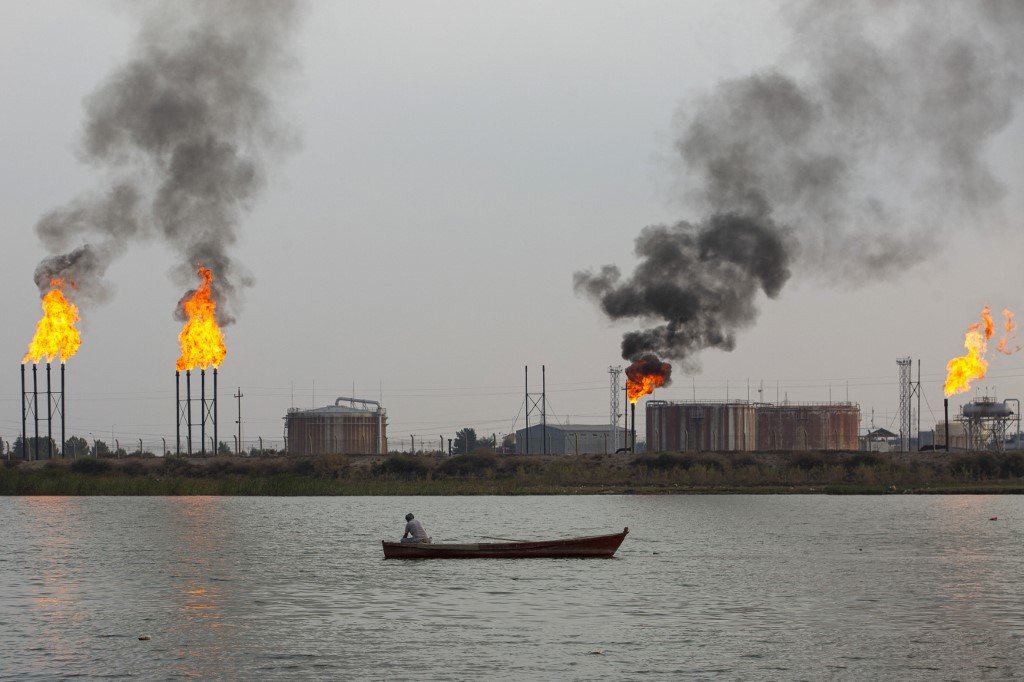
Iraq’s Basrah crude oil surged sharply even as global oil markets faced strong pressure. Basrah Heavy crude increased $2.11, or 3.47%, reaching $62.89 per barrel. At the same time, Basrah Medium crude rose $2.11, or 3.34%, to $65.34 per barrel. These gains mark one of the largest daily increases for Iraqi crude in recent weeks.
Meanwhile, global benchmarks struggled. Brent crude futures fell $1.44, or 2.07%, to $68.02 per barrel. US West Texas Intermediate (WTI) crude declined $1.34, or 2.06%, to trade at $63.80 per barrel. Analysts said that global oversupply and weaker demand contributed to these drops. Despite this, Basrah crude showed remarkable resilience.
Experts explained that local factors supported the Iraqi market. Production stability at Basrah terminals helped maintain steady supply. In addition, regional demand from Asian importers remained strong. Therefore, Iraqi exports held value even as international prices softened. Traders emphasized that these dynamics differ from global trends.
Investors also focused on the relative strength of Basrah Medium crude. It remains more resilient than Brent or WTI due to logistical advantages. Efficient loading operations at Basrah ports allow quick delivery to global buyers. Furthermore, shipping costs for Basrah crude are lower than for other grades. Consequently, Iraq benefits from stronger competitiveness in export markets.
Analysts added that geopolitical factors also influence Basrah crude prices. Political stability in southern Iraq reassured investors. In addition, agreements with foreign oil companies guarantee steady production levels.
Traders noted that Basrah crudes continued defying global trends during the week. While international benchmarks fluctuated, Iraq maintained its pricing strategy. Local supply and demand dynamics provided a temporary shield against worldwide declines. As a result, Iraq continues to secure higher revenues from oil exports despite external volatility.
Market observers highlighted the importance of Basrah crudes for Iraq’s economy. Oil revenues represent the largest share of national income. Rising crude prices directly impact government budgets and public spending. Analysts argued that maintaining strong Basrah prices could offset losses from weaker global benchmarks.
Overall, Basrah crude oil demonstrates resilience in a volatile global environment. Strong production, regional demand, and logistical advantages support its gains. Consequently, Iraq strengthens its position in the global energy market while securing vital revenues for economic stability.