

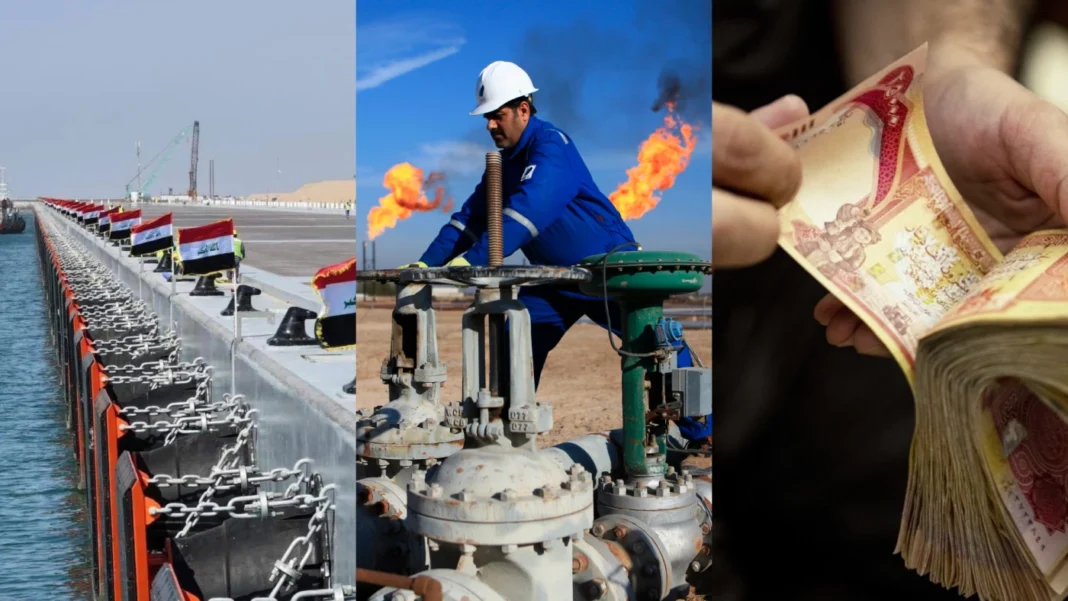
The Iraq economic outlook has come under renewed scrutiny after new forecasts pointed to several challenging years ahead. Recent projections suggest the country may experience continued economic weakness before returning to stronger growth later in the decade. Economic experts believe regional instability and trade disruptions remain key factors behind the expected slowdown.
According to the latest global economic projections, Iraq’s economy is expected to contract by 2.2 percent in 2026. The decline may deepen further in 2027, when economic output could shrink by 8.9 percent. These forecasts follow a period of uneven performance that has raised concerns among policymakers and investors.
Economic data shows Iraq recorded modest growth of 0.5 percent in 2024. However, estimates indicate the economy contracted by 1.5 percent during 2025. Analysts expect the downward trend to continue over the next two years before conditions begin to improve.
Several factors have contributed to the weaker Iraq economic outlook. Regional tensions have increased uncertainty across important trade corridors. Businesses also face higher transportation costs, which have placed additional pressure on commercial activity. These developments have affected economic confidence throughout the region.
The World Bank noted that Iraq remains particularly sensitive to events unfolding across the Middle East. As a result, its growth projections appear weaker than those of several neighboring oil-producing countries. Economic performance in the region continues to vary depending on local conditions and policy responses.
Saudi Arabia is expected to achieve economic growth of 3.1 percent in 2026. The United Arab Emirates may record growth of 2.4 percent during the same year. Kuwait, however, could face economic contraction, with forecasts pointing to a decline of 6.4 percent. These figures highlight the differing challenges and opportunities facing regional economies.
Meanwhile, the International Monetary Fund has also warned about the risks confronting Iraq. The organization expects regional turmoil to place pressure on government finances and consumer prices. Rising costs could create additional challenges for economic management in the coming years.
Trade disruptions remain another important concern. Iraq relies on regional commercial routes that support the movement of goods and services. Any interruption along these routes can affect supply chains and increase costs for businesses and consumers alike.
Particular attention remains focused on shipping lanes linked to the Strait of Hormuz. This strategic passage plays a major role in regional trade and energy exports. Ongoing military tensions near key routes could influence commercial activity and economic performance.
Despite the current challenges, long-term forecasts offer some optimism. Analysts expect Iraq’s economy to rebound strongly in 2028. Current projections suggest growth could reach 12.2 percent if conditions improve and regional pressures ease.
For now, the Iraq economic outlook reflects a period of uncertainty marked by geopolitical risks, trade challenges, and economic adjustments. Government officials and international institutions will continue monitoring developments closely. Their actions over the next several years may play a significant role in shaping Iraq’s economic recovery