

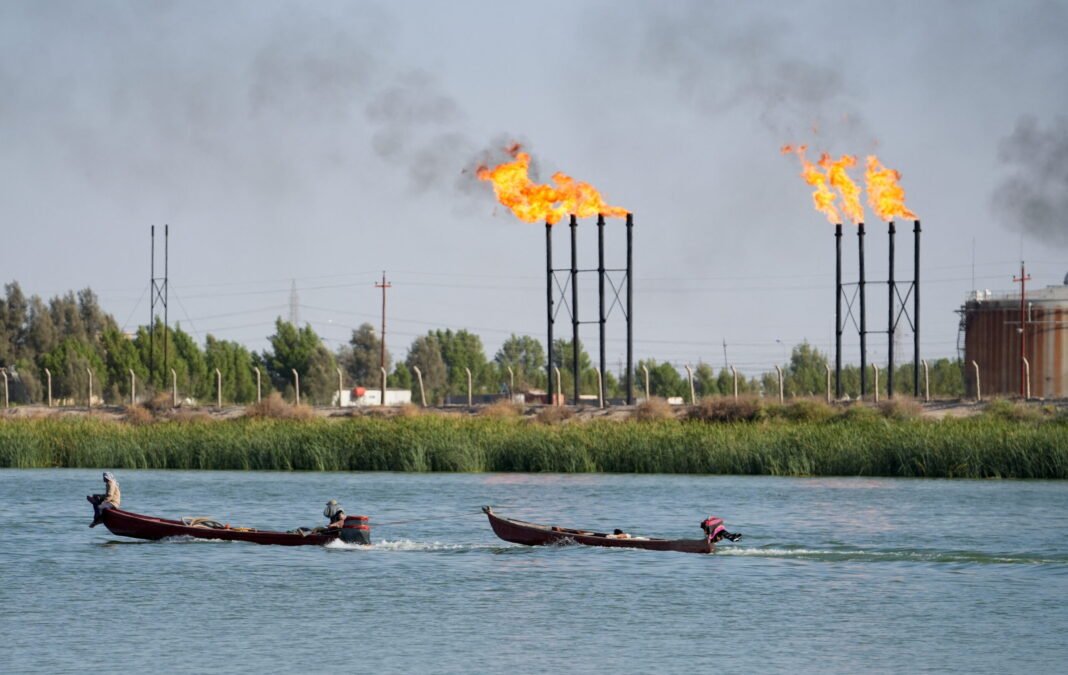
Basrah crude oil prices climbed on Tuesday, even as global oil markets saw significant losses. This divergence highlights shifting dynamics in regional demand and market sentiment. Interestingly, Basrah oil prices rise despite global dropremained a key market theme throughout the day.
Basrah Heavy crude increased by $2.60, or 2.85%, reaching $74.22 per barrel. Meanwhile, Basrah Medium crude gained $2.11, or 2.81%, settling at $77.22 per barrel. Both benchmarks moved higher as traders placed more value on Iraqi oil, particularly in Asian markets.
In contrast, global oil prices declined sharply. Brent crude futures dropped $2.08, or 2.9%, closing at $69.40 per barrel. U.S. West Texas Intermediate (WTI) crude fell $2.03, or 3.0%, ending the session at $66.48 per barrel. These losses came as geopolitical tensions in the Middle East began to ease following a ceasefire agreement between Iran and Israel.
Traders attributed the gains in Basrah prices to localized demand and stable export volumes. While global investors reacted to easing war concerns, regional buyers remained focused on securing long-term supply contracts from Iraq. As a result, Basrah oil prices rise despite global drop became a rare trend bucking the broader selloff.
The upward movement also reflects tighter availability of certain heavy and medium crude blends, especially in Asia. Several refineries continue to favor Basrah grades for their refining profiles. Market participants expect this demand to remain firm, at least in the short term.
Additionally, Iraq has maintained steady export flows through the Gulf, unaffected by recent drone activity and security concerns in neighboring areas. This reliability supports confidence in Basrah crude pricing, even during periods of global price volatility.
Global oil prices, however, are under pressure due to declining risk premiums. The recent ceasefire between Iran and Israel lowered fears of a wider regional conflict. This development encouraged traders to offload crude positions that had surged on war-related uncertainty.
Still, the performance of Iraq’s oil benchmarks indicates that regional factors continue to play an important role in pricing. As long as demand for Basrah grades remains strong, local prices may defy broader trends.
In summary, Basrah oil prices rise despite global drop remains a striking contrast in today’s oil markets, driven by regional stability and targeted demand.