

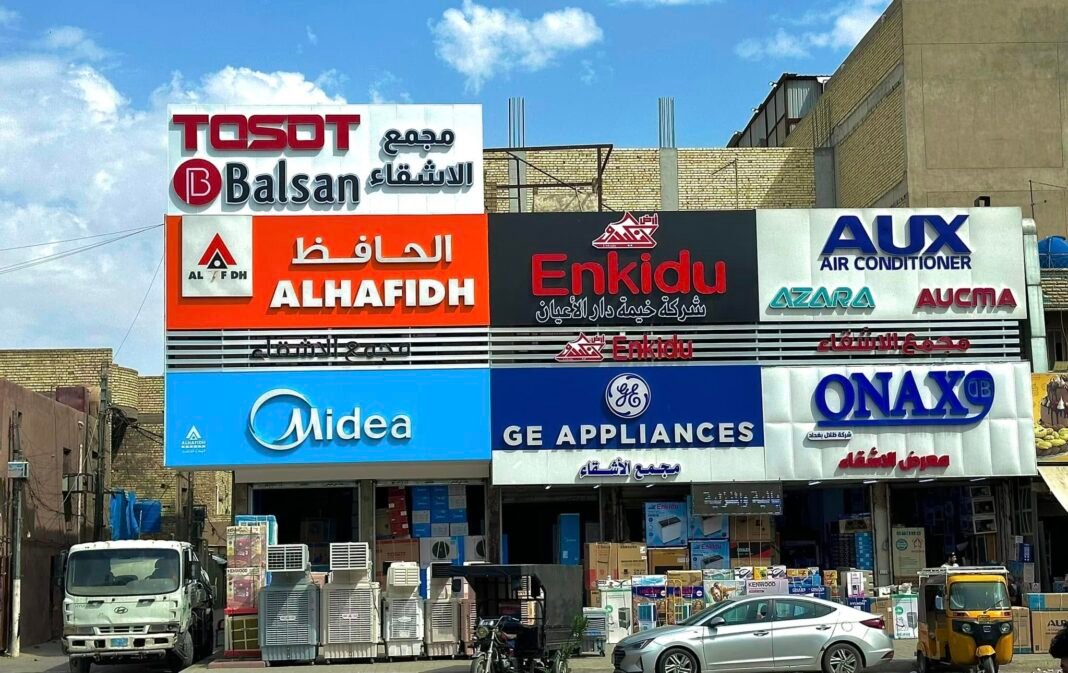
Iraq cooling unit prices have surged across Baghdad as intense summer heat fuels demand while supplies continue to shrink. Retailers say customers are paying far more for air conditioners and refrigerators than they did just months ago. The shortage has also reduced the availability of well-known international brands. As a result, many families now struggle to find reliable cooling equipment at affordable prices.
Air conditioners and refrigeration units have become increasingly scarce in markets across the capital. Split-unit air conditioners remain the most popular choice during the hottest months. However, retailers say limited inventories have pushed prices sharply higher. Many stores now carry only a small selection of cooling products.
Ahmad Mudhaffar, who owns an electrical appliance shop in Baghdad’s Al-Karrada district, said prices have risen dramatically. Cooling appliances that previously sold for less than IQD 1 million now cost around IQD 1.5 million. That equals an increase from roughly $763 to $1,144. He blamed unpredictable shipping costs and customs tariffs for raising import expenses and discouraging many traders from ordering new stock.
Mudhaffar said the higher prices have also reduced customer purchasing power. Many shoppers postpone purchases because they cannot afford current market rates. Some importers have delayed new shipments while waiting for conditions to improve. He believes consumers face the biggest challenge because quality products have become both scarce and expensive.
Other traders report similar conditions across Baghdad. Appliance dealer Salman Dhiab said customs duties and stricter tariff enforcement have increased business costs. Some companies have postponed collecting shipping containers from border crossings and ports. Storage fees continue to accumulate while importers wait for lower costs or improved market conditions.
Retailer Ali Abd Aoun said quality appliances once filled most electrical stores. Today, only a limited number of suppliers offer internationally recognized brands. He pointed to one popular split-unit air conditioner that increased from about IQD 750,000 to IQD 1.5 million, or from roughly $572 to $1,144. That price jump reflects the pressure facing both sellers and buyers.
The shortage has forced many consumers to choose cheaper alternatives. Baghdad resident Wasan Ali said she searched for high-efficiency cooling equipment from trusted international manufacturers without success. Most available products came from lesser-known brands. She said many buyers accept lower-quality appliances because they have no practical alternative.
Another customer, Hussein al-Abadi, shared a similar experience. He said several appliances purchased in recent months stopped working soon after installation. His experience reflects growing concerns about product quality as supplies tighten across the market.
Officials at Umm Qasr Port reject claims that shipping delays alone caused the shortage. A port source said cargo arriving for Iraq is unloaded quickly to avoid additional penalties. The source explained that containers currently stored at the port are destined for Turkiye. Several vessels also remain outside the port because of tensions around the Strait of Hormuz, a key route that carries nearly 20% of global oil supplies.
Government policy has also affected the appliance market. Council of Ministers Resolution 957, issued in October 2025, reactivated customs tariff enforcement after years of limited implementation. The updated system introduced tariff rates ranging from 5% to 30%, depending on the imported goods. Before the change, importers paid a fixed customs fee of IQD 3 million to IQD 4 million per shipping container, or approximately $2,289 to $3,051, regardless of the shipment’s value.
Market participants expect prices to remain elevated while demand stays strong and inventories remain limited. Until supply conditions improve, Iraq cooling unit prices will likely continue to pressure household budgets. Consumers and traders alike will watch closely for signs of lower import costs and stronger product availability as the summer season continues and Iraq cooling unit prices remain in focus.