

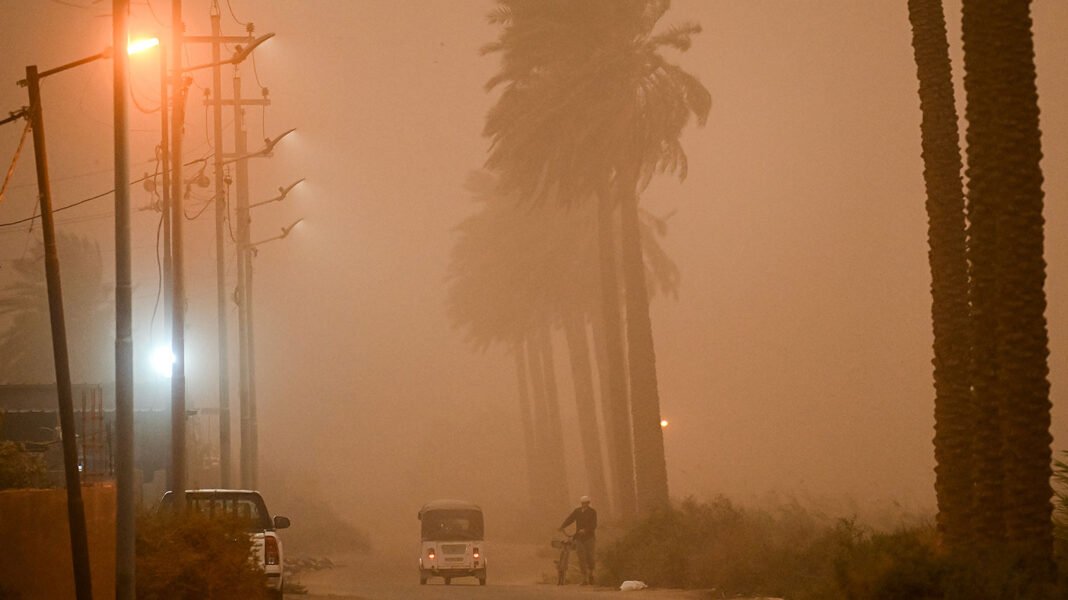
Iraq dust storms in focus after a powerful storm swept across Baghdad, turning the skies yellow and severely reducing visibility. Meteorologists expect more dust activity in early May, but calmer weather should return in the second half of the month as summer approaches.
Meteorologist Sadeq Al-Attiya explained that spring in Iraq often brings unstable weather patterns. These changes result from cold air masses from Europe meeting warm currents from the Arabian Peninsula. He noted that “Khamsin lows,” which reappear roughly every 50 days, also play a key role in driving storms.
Al-Attiya pointed out that dry conditions in western Iraq contribute heavily to the formation of dust storms. When rainfall is low, desert areas lose vegetation, allowing winds to lift large amounts of dust. Iraq dust storms in focus reflect how climate patterns, land degradation, and desertification increase storm frequency.
According to Al-Attiya, other regions beyond Iraq also add to the dust problem. He mentioned eastern Syria as a major source, where severe desertification has taken hold. Within Iraq, southern regions and Al-Anbar province face similar challenges due to low rainfall and shrinking greenery.
A thick dust storm blanketed Baghdad. The capital experienced a sharp drop in visibility, and yellow dust covered the streets, giving the city an eerie look. The General Traffic Directorate quickly issued warnings for drivers. Officials urged motorists to slow down, turn on hazard lights, and stop driving entirely if visibility became dangerously low.
Weather conditions are expected to improve gradually after mid-May. By then, meteorologists forecast a shift into Iraq’s dry summer phase. During this period, northwesterly winds dominate the weather for 40 to 45 days. Although they bring heat and dryness, these winds can also cause more dust storms, especially during the middle of the day.
Iraq dust storms in focus reveal how environmental issues and seasonal weather shifts combine to disrupt daily life. As dust events increase, public safety and infrastructure become harder to manage. Clearer skies and more stable conditions are expected by late May, giving residents a break from the stormy spring.
In conclusion, Iraq braces for more dust in the coming days but looks ahead to a more stable weather phase as summer nears. Until then, officials and citizens remain on alert.