

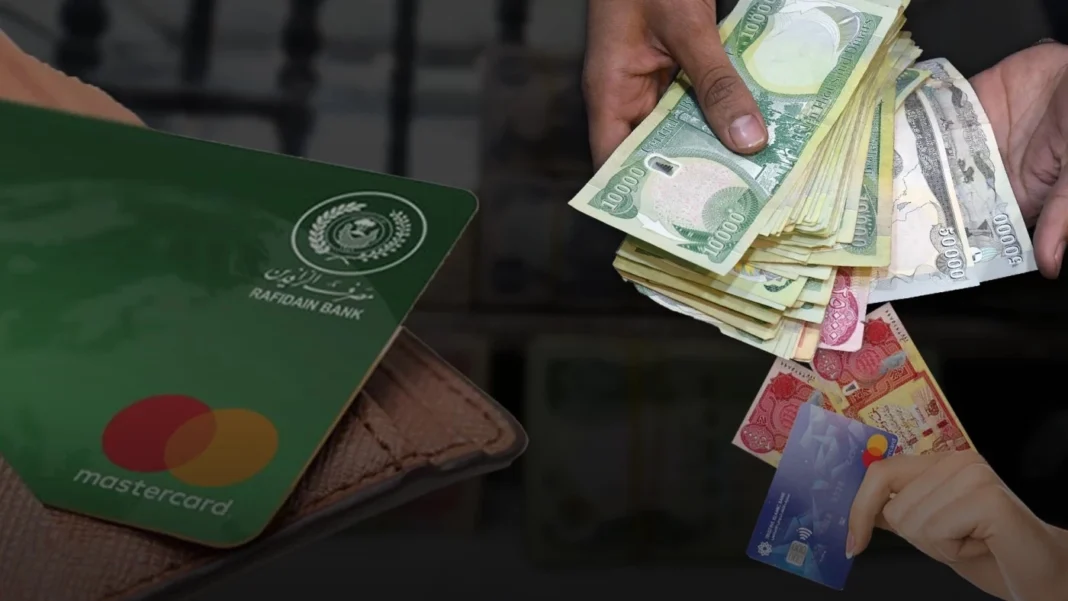
Cash payments in Iraq still dominate daily transactions across the country. However, banking cards continue to expand gradually. Many citizens still prefer physical money over digital tools. Therefore, the shift toward modern payments moves slowly.
First, economic data clearly show this trend. Experts confirm that cash payments in Iraq shape the financial system. Around 40% to 45% of money remains outside banks. Meanwhile, only 55% to 60% stays within banking institutions. This imbalance highlights strong dependence on cash.
Moreover, official figures provide deeper insight. The Central Bank reports 93.789 trillion dinars in circulation. In contrast, banks hold about 115.535 trillion dinars, equal to $79.7 billion. Despite this, people still rely heavily on cash. In fact, estimates show that 90% to 95% of transactions use physical money.
In addition, Iraq’s informal economy plays a major role. Many businesses operate outside formal systems. As a result, they prefer cash for speed and simplicity. Small markets and local shops depend on direct payments. Consequently, digital systems struggle to enter these spaces.
Furthermore, cultural habits strongly influence behavior. Many citizens trust cash more than digital tools. They worry about technical errors and hidden fees. Therefore, they avoid card payments in daily transactions. Even when people own cards, they often use them only for salary withdrawals.
On the other hand, signs of progress continue to appear. Electronic payment cards gain more attention in specific sectors. For example, fuel stations now accept card payments more frequently. Some service sectors also adopt digital tools. These developments reflect government reform efforts.
Additionally, authorities promote financial modernization programs. These programs aim to strengthen banking infrastructure. They also encourage citizens to adopt digital payments. However, adoption still requires time and trust.
At the same time, structural challenges slow progress. Iraq lacks a fully organized economic cycle. Many businesses remain unregistered. Property documentation also remains incomplete in several areas. Therefore, these gaps limit access to banking services.
Moreover, many consumers and merchants stay outside the financial system. This exclusion reduces the spread of electronic payments. Without widespread participation, digital tools cannot grow effectively.
Experts also stress the importance of trust. Banks must improve reliability and transparency. They should also introduce incentives like discounts and rewards. These steps can encourage people to shift away from cash.
However, forced implementation may create resistance. Experts warn against sudden changes. Iraq’s digital payment system remains relatively new. It only started developing about two years ago. Therefore, gradual change offers a more effective approach.
In conclusion, cash payments in Iraq continue to dominate despite ongoing reforms. Strong habits, structural gaps, and trust issues maintain this trend. Nevertheless, gradual improvements signal a slow but steady transition.