

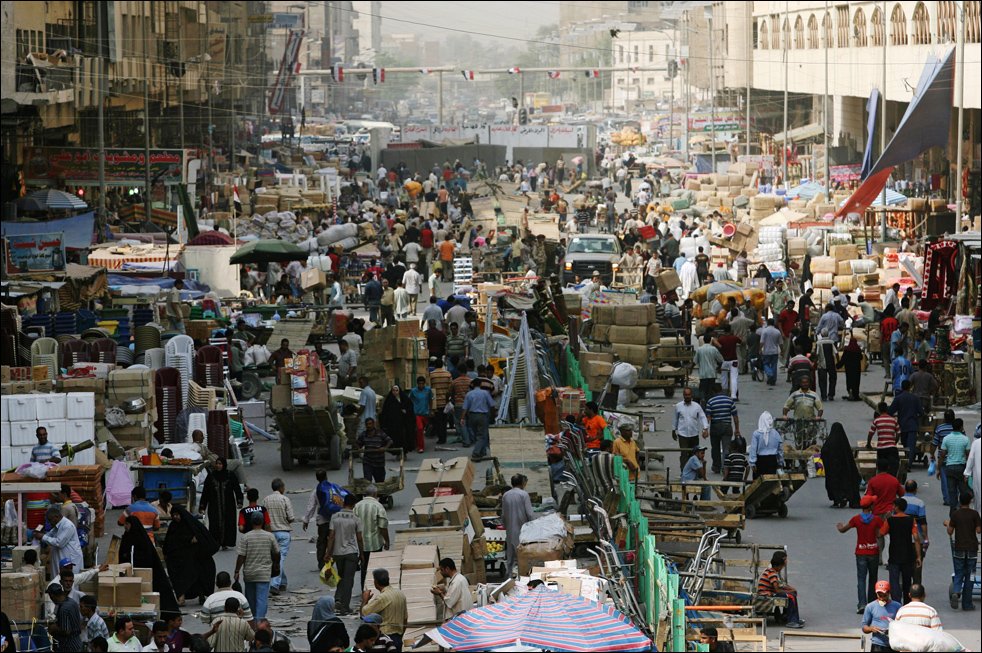
Economy in Iraq has entered a period of slowdown driven by both domestic weaknesses and external instability, the Baghdad Chamber of Commerce said. The chamber warned that without swift reforms, the country’s markets could remain stagnant for the foreseeable future.
Rashid Al-Saadi, spokesperson for the Baghdad Chamber of Commerce, told Shafaq News that Iraq is failing to produce enough food and industrial goods to meet local demand. He explained that the country’s limited infrastructure is unable to offset its heavy dependence on oil revenues. Non-oil income, he said, still represents only a minor share of total government revenues.
Additionally, Al-Saadi pointed out that widespread financial and administrative corruption, along with ongoing political crises, have deepened the economic stagnation. Rising unemployment and population displacement, particularly in the central and southern regions, have further weakened purchasing power and reduced overall market activity.
Therefore, he stressed the need for “greater government backing for Iraq’s negotiators to strengthen international relations and secure rapid solutions to the country’s economic challenges.” Building stronger foreign partnerships, he added, could help attract investment and ease Iraq’s financial strain.
Externally, Al-Saadi cited regional instability as another key factor undermining growth. The ongoing conflict between Iran and Israel, which erupted in June, has disrupted trade routes and created uncertainty in neighboring economies. He warned that renewed violence in the region could further harm Iraq’s fragile recovery and discourage investors.
A recent report by the Iraq Future Foundation for Economic Studies and Consultancy showed that Iraq’s monthly inflation rate increased slightly by 0.1% in October, while the annual rate declined by 0.3%. Although lower inflation benefits consumers, the report cautioned that it also reflects weakening economic demand.
Facing both internal corruption and external pressures, economy in Iraq now urgently needs diversification, stronger infrastructure, and sound governance to restore stability and growth.