

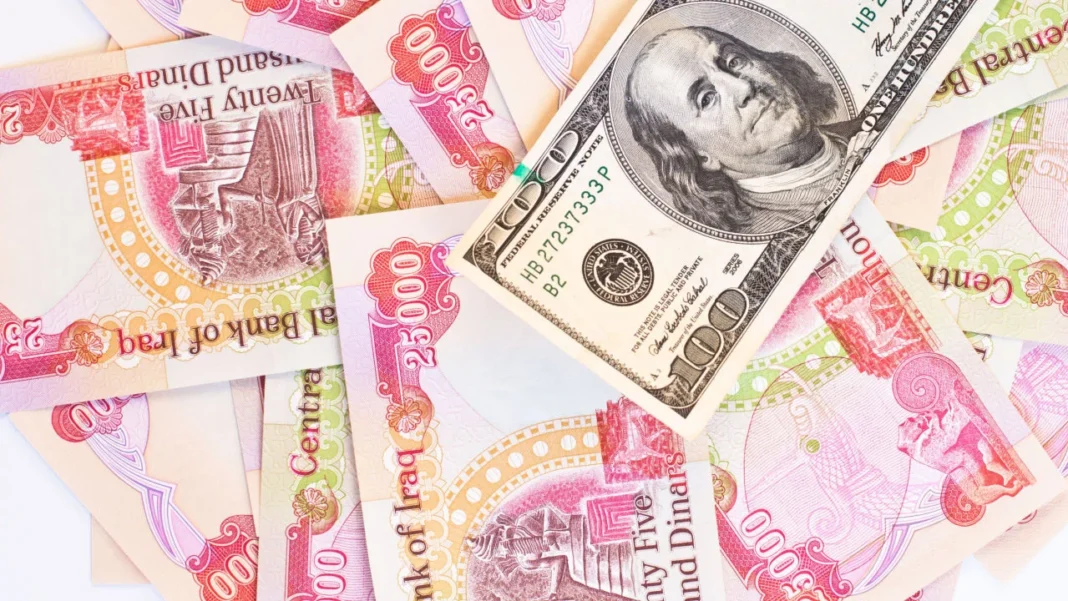
Iraq sees rising USD/IQD exchange rates, and Baghdad and Erbil report notable changes. Traders noticed the US dollar increase slightly against the Iraqi dinar. Market watchers said shifts reflect both domestic and regional economic factors. Analysts emphasize that tracking currency trends helps investors and businesses plan for costs, imports, and financial strategies. As a result, Iraq USD/IQD exchange rates gain attention among traders and citizens alike.
In Baghdad, the al-Kifah and al-Harithiya central exchanges recorded rates of 143,100 IQD per $100. This marks a small increase from the previous 143,000 IQD per $100. Local currency exchange shops showed stable activity, with selling prices around 143,500 IQD and buying prices near 142,500 IQD per $100. Officials noted that these figures indicate a gradual rise rather than sudden volatility.
Meanwhile, in Erbil, the dollar also gained momentum. Exchange shops reported selling rates of 142,100 IQD and buying rates of 141,950 IQD per $100. Observers mentioned that both Baghdad and Erbil markets demonstrate how closely local trading reflects national and regional currency movements. Traders increasingly monitor exchange rates to adjust their financial strategies accordingly.
Experts pointed out that several factors drive these changes. Regional market trends, trade flows, and government policies influence the US dollar’s value against the Iraqi dinar. Businesses relying on imports face higher costs when the dollar rises, while exporters may gain benefits from stronger foreign currency rates. Consequently, Iraq USD/IQD exchange rates affect everyday business decisions and economic planning across multiple sectors.
Additionally, analysts emphasized the role of market confidence. Stable selling and buying prices in local shops suggest that traders anticipate gradual shifts rather than sharp fluctuations. Baghdad and Erbil markets serve as indicators for the wider financial climate in Iraq, reflecting both demand for the US dollar and the strength of the dinar. Investors monitor these changes closely to make informed decisions.
Financial authorities recommend keeping track of official exchange rates, central bank updates, and market trends. Citizens and traders alike follow these figures to manage savings, imports, and expenditures efficiently. Meanwhile, regional events and global financial shifts may further influence the USD/IQD rate in the coming weeks.
In conclusion, Iraq USD/IQD exchange rates continue to rise modestly across Baghdad and Erbil. Traders see gradual increases rather than sudden surges, while businesses and investors adjust strategies accordingly. Close monitoring of these rates remains crucial for economic planning and financial decision-making in Iraq.