

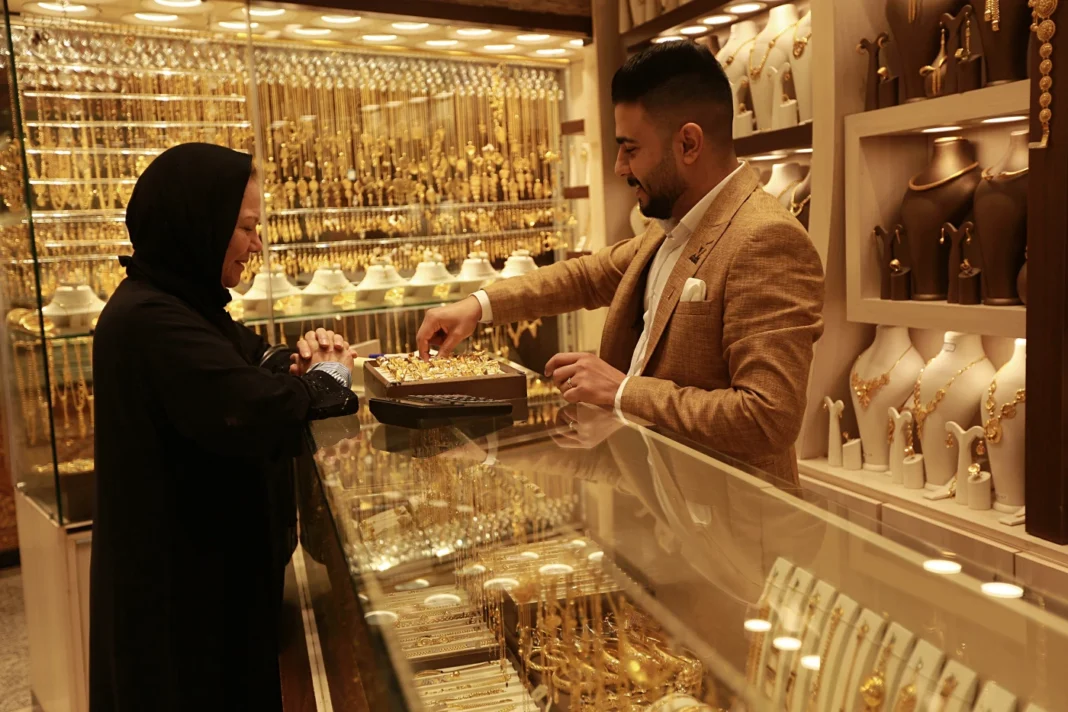
Gold prices in Iraq fell sharply across Baghdad and Erbil markets, signaling a shift in trading sentiment. Traders reported declines in both local and imported varieties, affecting buyers and sellers alike. Therefore, the recent movement indicates a short-term correction in the gold market.
In Baghdad, gold on Al-Nahr Street saw noticeable drops. The selling price for 21-carat gold, including Gulf, Turkish, and European types, reached 996,000 IQD per mithqal, down from 1.040 million IQD in the previous session. The buying price declined to 992,000 IQD per mithqal. Iraqi 21-carat gold sold for 966,000 IQD, with a buying price of 962,000 IQD.
Jewelry stores reflected similar changes. Gulf gold prices ranged from 995,000 to 1.005 million IQD per mithqal. Iraqi gold traded between 965,000 and 975,000 IQD. These shifts suggest buyers benefited from lower rates, while sellers adjusted prices to match market trends.
Erbil markets also showed falling gold prices. The selling rate for 22-carat gold reached 1.125 million IQD per mithqal. Twenty-one-carat gold sold for 1.075 million IQD, while 18-carat gold was priced at 922,000 IQD. Traders noted that these declines followed regional supply adjustments and shifts in demand.
Analysts attributed the fall to increased availability and moderate demand. Some gold inflows from import channels eased pressure on prices. Meanwhile, traders observed calmer market activity compared with the previous session, which reduced speculative buying.
The decline affects both investors and consumers. Investors saw a short-term reduction in asset value, while buyers enjoyed more affordable gold. Jewelry shops may adjust margins to maintain sales volume. Consequently, gold trading remains responsive to supply and demand dynamics.
Financial experts highlighted that gold prices fluctuate frequently in Iraq due to local and global influences. Regional market conditions, currency stability, and import patterns all play a role. Therefore, traders monitor trends carefully to avoid sudden losses.
Both Baghdad and Erbil markets continue to serve as key hubs for gold trade. The markets handle imported and domestic gold efficiently. Jewelry shops adjust pricing daily to reflect updated exchange rates and international gold trends. These actions ensure competitive and transparent pricing.
Overall, the recent drop in gold prices reflects temporary market correction. Traders expect moderate fluctuations in the coming sessions. Market observers encourage buyers and sellers to follow trends closely. Iraq gold prices remain a key indicator of broader economic sentiment.