

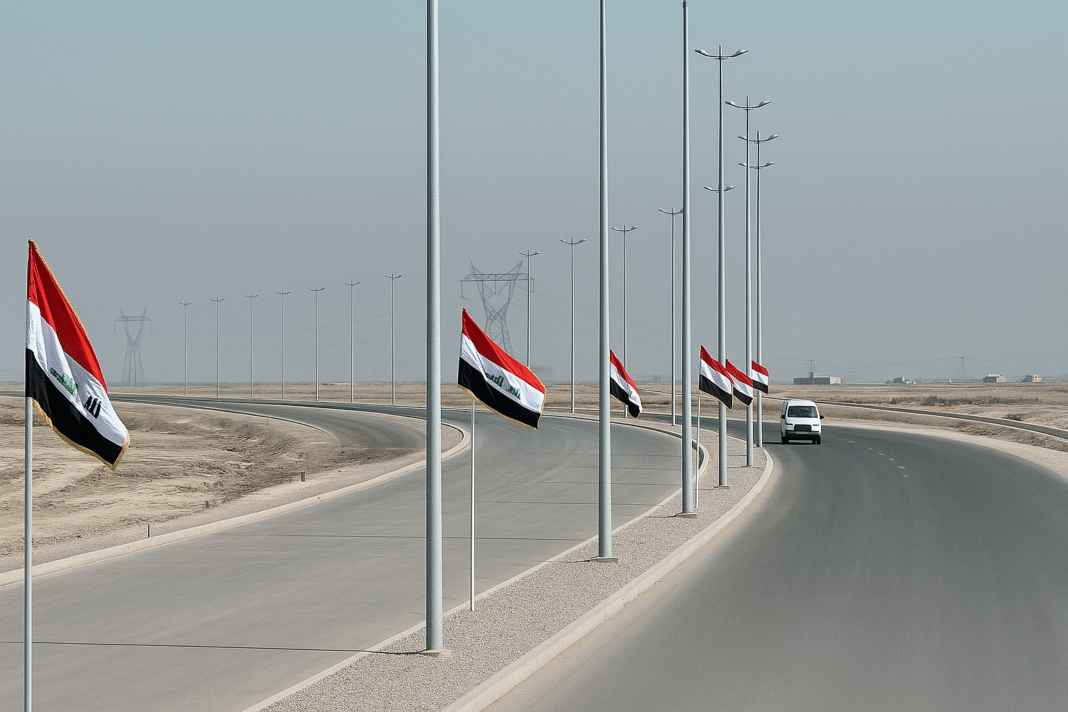
Iraq marked a major milestone as Development Road project begins with the completion of its first key section. Connecting Al-Faw Grand Port to Umm Qasr. The General Company for Ports of Iraq confirmed that the newly finished 62-kilometer road.
Therefore, the road includes three dedicated lanes for heavy trucks and features a high-standard safety wall to enhance security and vehicle flow. Moreover, the first completed section stretches 51 kilometers from Al-Faw Grand Port to an underwater tunnel, then extends another 11 kilometers.
Moreover, engineers also completed two major bridges—805 meters and 300 meters long—and installed solar-powered lighting systems to support sustainable energy use.
Additionally, the Al-Faw Grand Port project, launched as Iraq’s most ambitious maritime venture, aims to become the largest container port in the Middle East. Iraqi Transport Minister Razzaq Al-Saadawi said that the port’s first phase will finish by the end of 2025.
Therefore, this initial phase includes five fully built piers. The 62-kilometer highway, a 2,400-meter underwater tunnel beneath the Khor Al-Zubair Channel, a ship canal, and a container yard. These elements are key to integrating the port with Iraq’s broader transportation network.
Located on the Khor Abdallah Channel near the Shatt Al-Arab. The Al-Faw Port features container berths capable of handling ships with up to 23,000 twenty-foot equivalent units (TEUs). Built by South Korea’s Daewoo E&C. The five berths completed so far represent a leap in Iraq’s maritime capacity.
The entire port, once completed by 2038, will boast 100 berths and a total handling capacity of 7.5 million TEUs annually. The first phase alone will manage up to 4 million TEUs per year by 2028.
Therefore, Development Road project begins with the goal of transforming Iraq into a trade hub. The project’s overland routes will connect the southern port city of Basra to Turkey and, from there, to Europe. This $7 billion initiative rivals Egypt’s Suez Canal and positions Iraq as a vital bridge between Asia and Europe.
In addition, the broader strategy includes integrating oil and gas pipelines, highways, and a future railway. These infrastructure links will form the foundation of Iraq’s new economic future. It’s designed to connect regional powers and enhance global trade flow.
As a conclusion, with this step, Development Road project begins its journey toward making Iraq a regional logistics leader.